Your Custom Text Here

On Paper | Group show at Gallery Art Motif
On Paper
Artists: Chetnaa, Pierre Legrand, Ankon Mitra, Sachin George Sebastian, Ziya Tarapore, Sachin Tekade
Paper. A surface to write or draw or doodle or print. To mark or stain. A material to fold or layer, to cut, puncture or impress. Explored by artists as matter, method or metaphor, paper kindles a sense of nostalgia and a sense of being made by hand.
The versatility and potential of the material is witnessed in the range of forms it can inhabit- two-dimensional and three-dimensional, and the range of meanings it can represent- from fragility and ephemerality to weight and rigidity, from clean and pure to wrinkled and frayed. Marked in Paper explores the work of six contemporary artists who employ paper in their practices.
Ankon Mitra’s art practice is informed by his career as an architect and his involvement in landscaping and horticulture which have resulted, over the years, in a keen observation of the folding and unfolding of nature- the making and unmaking of mountains, rivers, all forms of plant and animal life. This constant flux defines the forces of growth, decay and change, across scales and temperaments. Describing the ‘fold’ as an act of renewal, Mitra renders forms based on the principles of origami and kirigami, where the application of a fold or a cut has the ability to create robust sculptural forms of seemingly flat sheets of paper. Organized into repetitive patterns, the folds explore gravity, light and volume.
The means by which nature occupies space, as witnessed for instance, in the unfurling of a new leaf- the form that inspires Mitra’s Bells of Light neither reduces nor enhances the resulting form, but rather transforms it. By exploring the physiological changes caused by light, and by morphogenesis, i.e. the process by which an organism, tissue or organ develops its shape, Mitra crafts a series of suspended paper sculptures that rely on folds, slits and accordion-like pleats that radiate outward, thereby also optimizing the use of space.
The play of light and shadow, of becoming and unbecoming is scripted as an abstract, sensorial language in the work of Pierre Legrand. Writer John Quinn in his 2001 curatorial essay ‘Speaking Light’ on Legrand’s work writes, “While talking to me about his work one day, Pierre cited Castaneda, who said that when looking at a tree, one should not observe the leaves, but the spaces between the leaves. Indeed, one of the first things one notices about Pierre’s ‘alphabets’ is that the letters are but empty spaces – it is only the material around them that is physical.” Legrand shares with Mitra a geometric sensibility and a codified methodology of unravelling the intrinsic nature of our surroundings and the materials that they contain. Light Matter, 2001 is magical and fabulous in the way it immerses its viewer within its tall and thin perforated paper walls, and yet at another level, suggests the porosity of language.
Ziya Tarapore also draws from nature; her works underpinning elements of fantastical otherworldliness. The bright colours and shapes of her multi-layered foliage pieces merge into amorphous underwater creatures with shaded and camouflaged bodies, and textures that seem to grow and shrink at once. Trained in textile and driven by the use of colour, Tarapore’s art evolves beyond her observations of nature and flora, to also inadvertently probe the relevance of craft and design to artistic practices. Can something that is aesthetically beautiful also be a critical work of contemporary art?
From a burst of colour, to the purity of the colourless. Sachin Tekade’s practice is an engagement in white- as colour, as sound, as space, as smell, as touch. Tekade’s works are expressions of phenomena that maintain the natural balance- at a perceptible human level, and at a cosmic level of waves of light, sound and air. The resultant art emerges as tactile engagements with subtle elemental nuances that register fluctuations from the natural order, either occurring organically or as a consequence of human activity. Inspired by futuristic architecture, Tekade’s work explores repetitive patterns that together form a whole, and minimalist forms that seem to hold copious amounts of pulsating energy. His series Absencefocuses on the immaterial and abstract, the emblematic and pure.
Steeped in the architectural landscape of our metropolises is the work of Sachin George Sebastian and Chetnaa. Sebastian considers the chaos of the Indian city through multi-layered paper renditions of built environments- tall and short buildings, roads, sidewalks and bridges, shiny lights, sirens, horns and a cacophony of voices, that spiral outward from compositely framed natural forms of flowers and foliage. Responding to the appeal of the fast-paced competitive energy of the Indian city, Sebastian highlights the grueling rigor of its spaces, sights and sounds. Closer examination of his beautiful constructions reveals the anxiety of being one of many in the rat race, where the fragility of our bodies and desires is echoed in thin strips of paper.
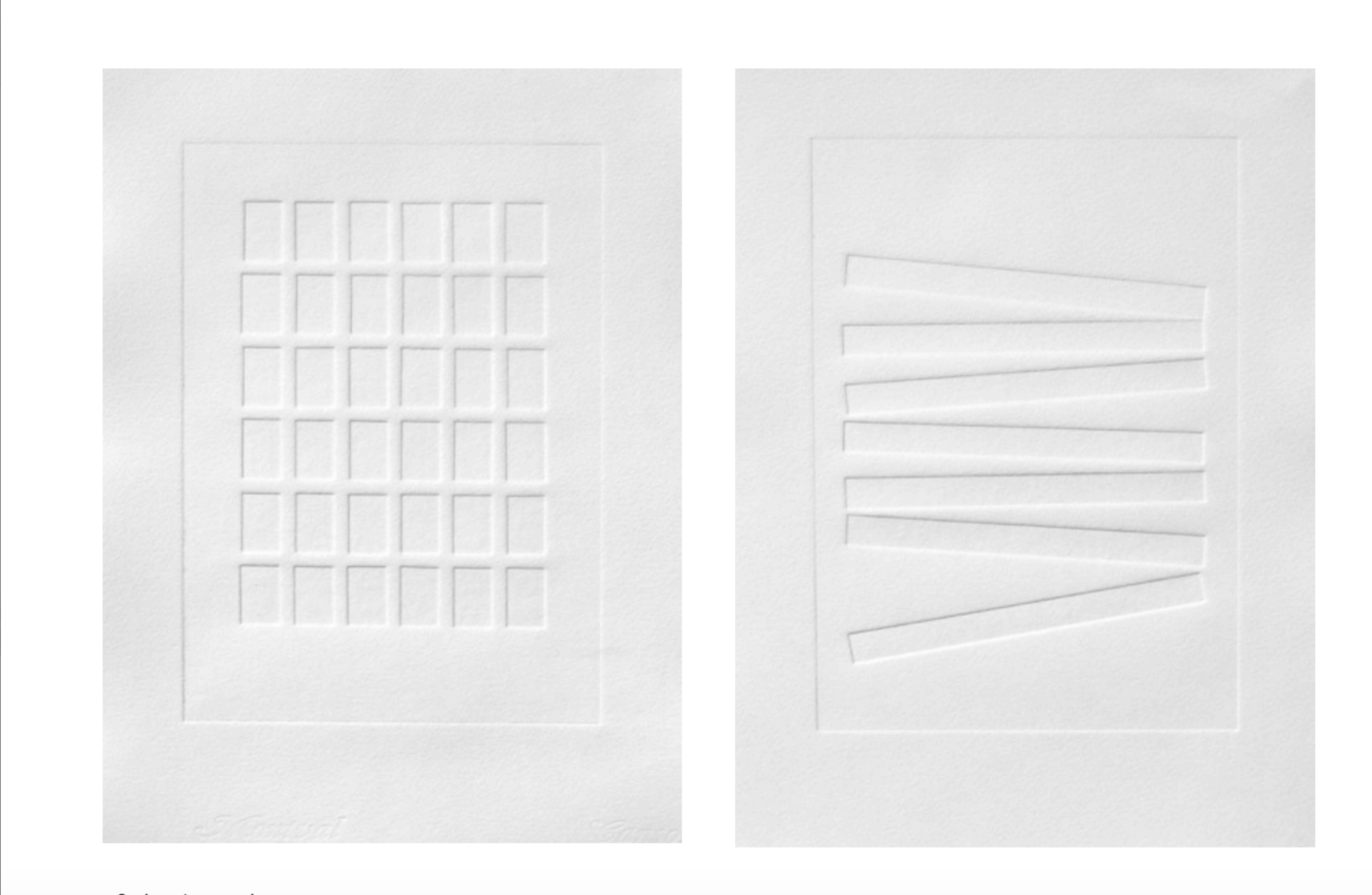
Chetnaa’s work on the other hand, are personal impressions of the city’s architecture. Her series of embossed blocks on paper, rising both vertically and horizontally, speak of our progressively growing footprint on the land we occupy. Devoid of colour, and expressly pressed into the paper, her work recalls the building blocks of alleged development- of cities growing and spaces shrinking in the manner in which blocks are stacked in rows or columns, or arranged as grids or pyramids. Some are shaky while others are stable and static. Her use of the line and her language of abstract geometry shapes her minimalistic practice.
Marked in Paper is an exploration of forms that shape our natural and constructed environment, fuelling an understanding of its limits and its immensity. The six artists share a knowledge of geometry and an interest in the structural make-up of our surroundings- natural and man-made, that then expresses in different ways, in and of paper.
Kanika Anand
Vancouver, 2019
On Paper
Artists: Chetnaa, Pierre Legrand, Ankon Mitra, Sachin George Sebastian, Ziya Tarapore, Sachin Tekade
Paper. A surface to write or draw or doodle or print. To mark or stain. A material to fold or layer, to cut, puncture or impress. Explored by artists as matter, method or metaphor, paper kindles a sense of nostalgia and a sense of being made by hand.



The versatility and potential of the material is witnessed in the range of forms it can inhabit- two-dimensional and three-dimensional, and the range of meanings it can represent- from fragility and ephemerality to weight and rigidity, from clean and pure to wrinkled and frayed. Marked in Paper explores the work of six contemporary artists who employ paper in their practices.
Ankon Mitra’s art practice is informed by his career as an architect and his involvement in landscaping and horticulture which have resulted, over the years, in a keen observation of the folding and unfolding of nature- the making and unmaking of mountains, rivers, all forms of plant and animal life. This constant flux defines the forces of growth, decay and change, across scales and temperaments. Describing the ‘fold’ as an act of renewal, Mitra renders forms based on the principles of origami and kirigami, where the application of a fold or a cut has the ability to create robust sculptural forms of seemingly flat sheets of paper. Organized into repetitive patterns, the folds explore gravity, light and volume.
The means by which nature occupies space, as witnessed for instance, in the unfurling of a new leaf- the form that inspires Mitra’s Bells of Light neither reduces nor enhances the resulting form, but rather transforms it. By exploring the physiological changes caused by light, and by morphogenesis, i.e. the process by which an organism, tissue or organ develops its shape, Mitra crafts a series of suspended paper sculptures that rely on folds, slits and accordion-like pleats that radiate outward, thereby also optimizing the use of space.
The play of light and shadow, of becoming and unbecoming is scripted as an abstract, sensorial language in the work of Pierre Legrand. Writer John Quinn in his 2001 curatorial essay ‘Speaking Light’ on Legrand’s work writes, “While talking to me about his work one day, Pierre cited Castaneda, who said that when looking at a tree, one should not observe the leaves, but the spaces between the leaves. Indeed, one of the first things one notices about Pierre’s ‘alphabets’ is that the letters are but empty spaces – it is only the material around them that is physical.” Legrand shares with Mitra a geometric sensibility and a codified methodology of unravelling the intrinsic nature of our surroundings and the materials that they contain. Light Matter, 2001 is magical and fabulous in the way it immerses its viewer within its tall and thin perforated paper walls, and yet at another level, suggests the porosity of language.
Ziya Tarapore also draws from nature; her works underpinning elements of fantastical otherworldliness. The bright colours and shapes of her multi-layered foliage pieces merge into amorphous underwater creatures with shaded and camouflaged bodies, and textures that seem to grow and shrink at once. Trained in textile and driven by the use of colour, Tarapore’s art evolves beyond her observations of nature and flora, to also inadvertently probe the relevance of craft and design to artistic practices. Can something that is aesthetically beautiful also be a critical work of contemporary art?
From a burst of colour, to the purity of the colourless. Sachin Tekade’s practice is an engagement in white- as colour, as sound, as space, as smell, as touch. Tekade’s works are expressions of phenomena that maintain the natural balance- at a perceptible human level, and at a cosmic level of waves of light, sound and air. The resultant art emerges as tactile engagements with subtle elemental nuances that register fluctuations from the natural order, either occurring organically or as a consequence of human activity. Inspired by futuristic architecture, Tekade’s work explores repetitive patterns that together form a whole, and minimalist forms that seem to hold copious amounts of pulsating energy. His series Absence focuses on the immaterial and abstract, the emblematic and pure.
Steeped in the architectural landscape of our metropolises is the work of Sachin George Sebastian and Chetnaa. Sebastian considers the chaos of the Indian city through multi-layered paper renditions of built environments- tall and short buildings, roads, sidewalks and bridges, shiny lights, sirens, horns and a cacophony of voices, that spiral outward from compositely framed natural forms of flowers and foliage. Responding to the appeal of the fast-paced competitive energy of the Indian city, Sebastian highlights the grueling rigor of its spaces, sights and sounds. Closer examination of his beautiful constructions reveals the anxiety of being one of many in the rat race, where the fragility of our bodies and desires is echoed in thin strips of paper.
Chetnaa’s work on the other hand, are personal impressions of the city’s architecture. Her series of embossed blocks on paper, rising both vertically and horizontally, speak of our progressively growing footprint on the land we occupy. Devoid of colour, and expressly pressed into the paper, her work recalls the building blocks of alleged development- of cities growing and spaces shrinking in the manner in which blocks are stacked in rows or columns, or arranged as grids or pyramids. Some are shaky while others are stable and static. Her use of the line and her language of abstract geometry shapes her minimalistic practice.
Marked in Paper is an exploration of forms that shape our natural and constructed environment, fuelling an understanding of its limits and its immensity. The six artists share a knowledge of geometry and an interest in the structural make-up of our surroundings- natural and man-made, that then expresses in different ways, in and of paper.

Lines of Sight | Kumaresan Selvaraj at Exhibit 320, New Delhi

Cultural perception or the language in which we think and articulate our thoughts has a direct bearing on our worldview and the manner in which we understand materials. From the early twentieth century, anthropologists and psychologists have linked our perceptive and cognitive faculties in order to better understand the influence of cultural conditioning on the way we observe and represent our surroundings. It is this ‘sense of sight’ that shapes the art of Kumaresan Selvaraj; drawn from perceived information and recalled memories. Materialized into objects and abstractions of nature, Selvaraj’s layered works are as much explorative of the limits of materiality, as they are rooted in the culture of India, more specifically in the Tamil culture of South India, to which the artist was born and where he continues to reside.
How does culture shape cognition? To what extent is perception controlled by the mind in relation to the senses ? How do we extract an individual thought from collective consciousness, or separate the contexts of high and low cultures, the rubric of East and West customs and the languages in which different societies communicate and share knowledge, in order to assess the impact of social structures on perception? Spatial dimensions for instance, are understood in absolute terms- North, South, East and West in Western cultures, while they are taught and communicated in relative terms- left, right, forward, backward in Eastern cultures. Such differences that affect our perception and the manner of representation of objects and ideas fuel Selvaraj’s diverse art practice.
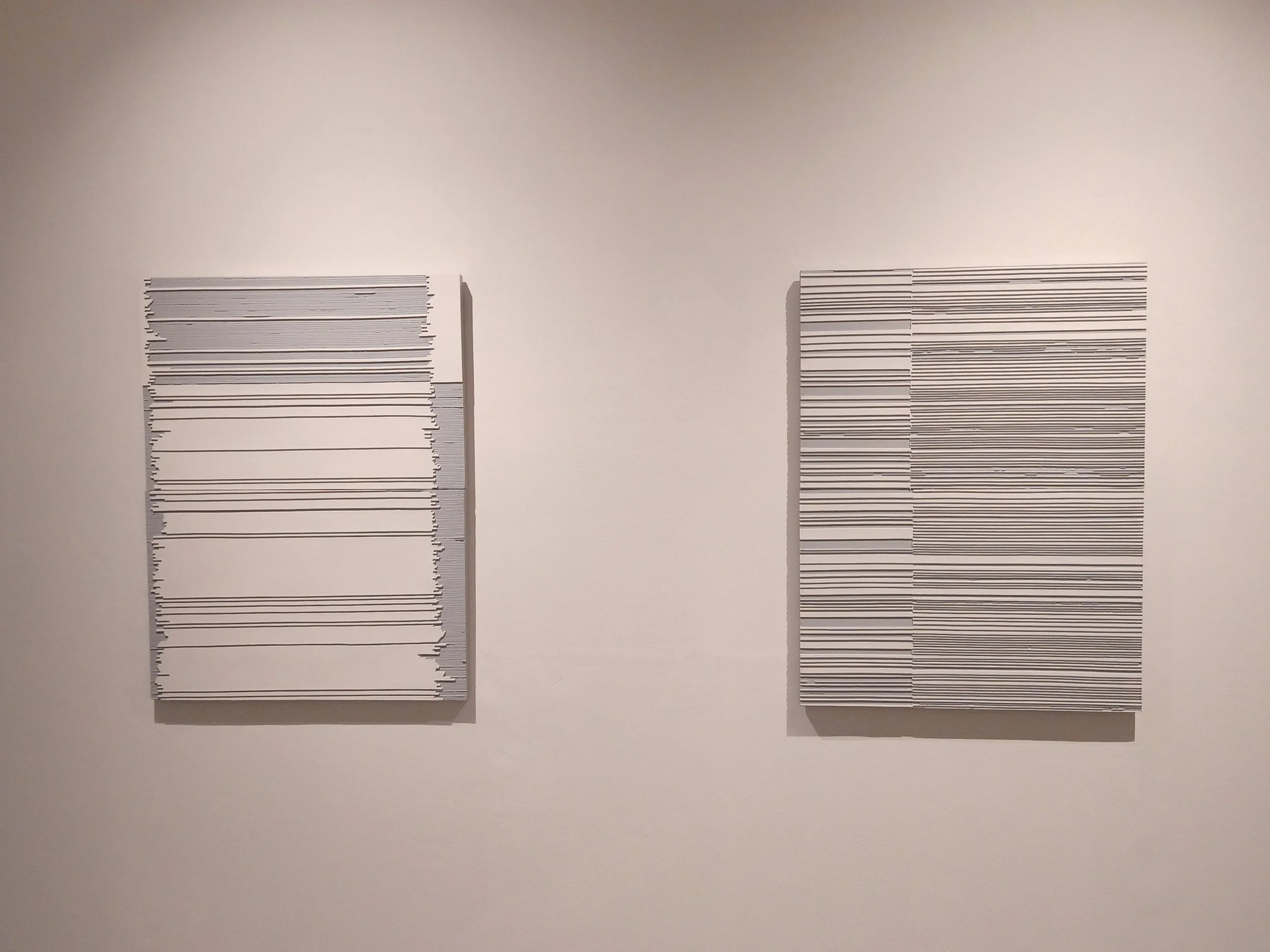
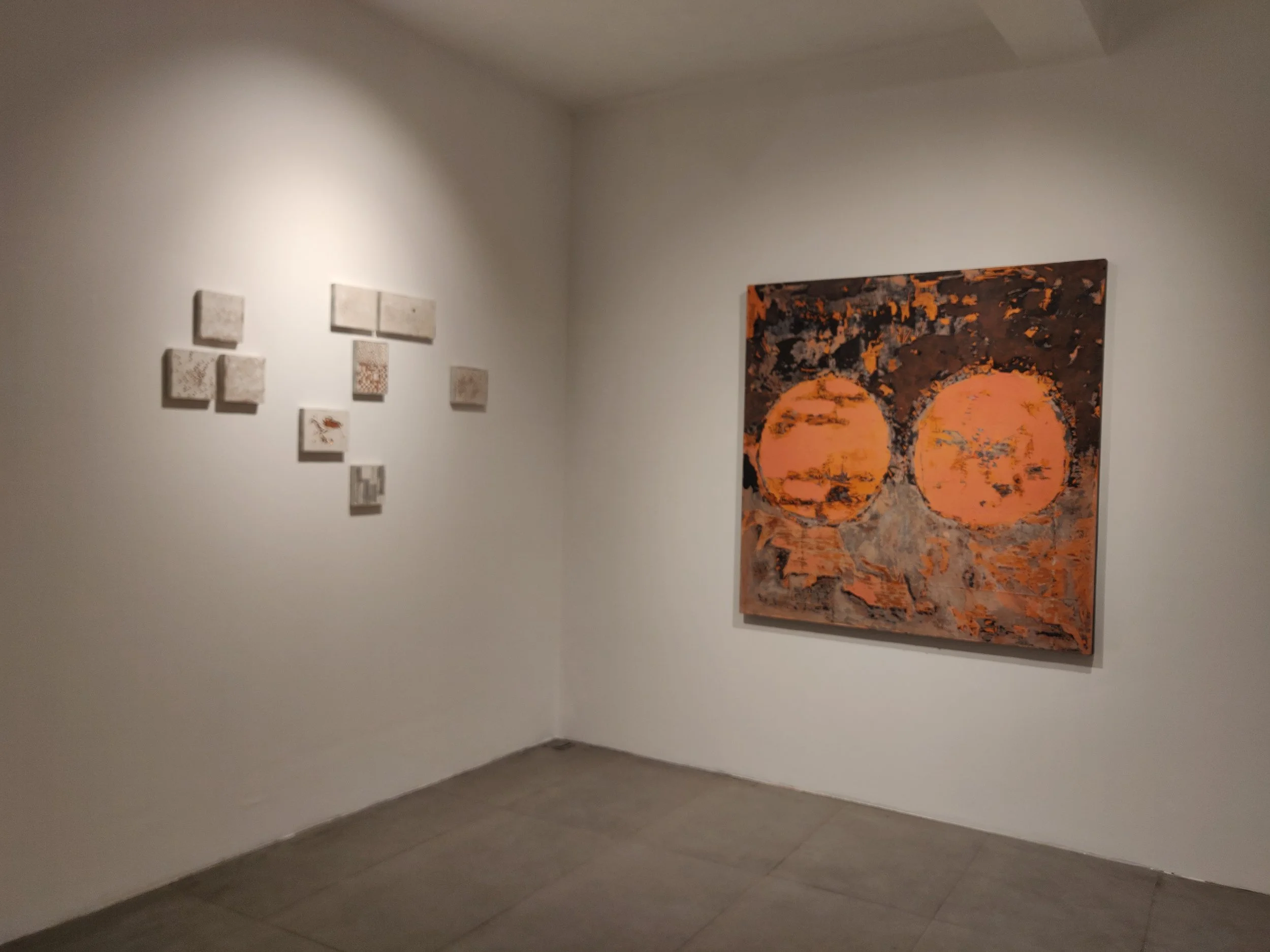
The show gathers three series of recent works that reflect the artist’s continuing interest in understanding our relationship with the natural world. While questioning the physicality of our own bodies and that of the objects around us, Selvaraj also throws up questions of embodiment and containment. In probing the agency of the mind and the body to contain our thoughts and direct our actions, Selvaraj’s desire for freeing ourselves of predisposed emotions and judgements and the monotony of repeated mechanical actions becomes even more pronounced. This want for freedom is discernible in the interplay between stacks of straight and jagged horizontals in the three Untitled (2019) works of fibreglass and acrylic. The asymmetrical calibration of the horizontal rows, executed in relief, releases the lines from both linearity and two-dimensionality, while lending to the incidental creation of vertical columns on the same surface. Horizontality, has for the most part, defined our sense of time and space by way of the horizon line and so, a breakage here reveals a need to realign our own faculties of understanding, towards discovering a new norm. A similar want for freedom is expressed in the series of four paintings Untitled (2018) works of paper and acrylic on board- textured and bridled by the mind’s eye, with layers chipping away, revealing as it seems, the underbelly of our existence. Coloured in earthy hues of yellows, oranges and rusts, the fiery circle in the center of each frame echoes the unending circling of life, and the rhythm of how things go.




Of the third body of work, are a trio of pillars titled One Above the Other that belong to an ongoing series of the same name. Focusing on the pillar as a source of strength and support, the artist’s memories are stacked tall until they coil at the top, free of their narrow structural abode, yet stubbornly recoiling back to their original nature. Using the medium of paper, Selvaraj dissects the nature of memories that are singularly fragile but that which collectively reinforce our personalities and govern our associations with the world. By repurposing a multitude of magazine papers, each containing a certain piece of information, Selvaraj magnifies the scrambled manner in which we react to stimuli and consume news. Does our own individuality get lost amidst what we have been fed and assume to be culturally and socially acceptable? Does the verticality and stratification of the pillars reveal the degrees of cultural hierarchies and the weight of our memories, as social beings?


A similar sentiment is echoed in the two other sculptures that also belong to the series One Above the Other. Like the grand old tree that has seen it all, many times over, the first is a towering sculpture that branches out into five sides, rooted in history and memory, but also growing upward and sideways in search of a path less traveled- a new way of seeing and thinking. The tree nevertheless, remains bound by the bulk of its trunk without which it cannot stand, let alone grow. The source of its stability is also the root of its burden.
The final sculpture and the last of the five works of the series in the show takes the form of two intersecting circles. Here, the artist’s preoccupation with cyclic change and repetition of action resurfaces again. Laid on the ground, the circles appear as cogs of a machine- wound and unwound, independent and yet connected. Each layer of memory keeps the engine working, albeit in the same way it has been programmed to function for generations.
Lines of Sight is an exhibition that voices the need for independent thinking and a desire to free our minds from the socio-cultural fabric that binds us. But it also firmly establishes the foundations from which we can grow and progress, and cultivate change.
Kanika Anand
New Delhi, 2019
References
Steyerl, Hito. In Free Fall: A Thought Experiment on Vertical Perspective, E-flux Journal #24, April 2011
(Ed) Dolphijn, Rick and Tuin, Iris van der.New Materialism: Interviews & Cartographies, 2013
Masuda, Takahiko & E. Nisbett, Richard,Culture and Change Blindness, 2006
Department of Psychology, University of Alberta & Department of Psychology, University of Michigan, Cognitive Science Journal (Volume 31, Issue 2) 2006, 381–399

A Place to Which We Belong | Shalina Vichitra at Gallery Art Motif, New Delhi

A Place to Which We Belong
Works by Shalina Vichitra
Gallery Art Motif, March 17- April 17, 2018
Some places stir a sense of nostalgia. Some places leave us vacant. Some places delight us while some others disturb us.
A place to which we belong focuses on forms of mapping that communicate our sensorial experiences of remembering or imagining a place, as opposed to being within or outside of it. Informed by the multifarious relationships that individuals and collectives have with their environment, the exhibition questions our personal understanding of place as a filtered sequence of encounters that encompasses its own set of narratives, aesthetic textures and subliminal thoughts.
For Shalina Vichitra, land not only offers itself as a visual metaphor of lived experiences but also a tactile archive. Her paintings function as visceral geographical annotations and recordings that employ the tools of cartography to address the complex subject of 'belonging'. The fragile balance between natural world and human habitation surfaces through lines and markings that conventionally help organize or delineate. Underlining her practice are moments of movement, of journeying- through paths and routes, across or within boundaries, between past and present, with the suggestion of an alternative possibility. Her work thus, serves as an abstract rendering of a concrete reality.
There is something subliminal about looking at the world from above- be it from a plane or the top of a mountain. The format of the aerial view divulges a plethora of earth patterns and temporal footprints, continually gathered and ever changing. Within it, Vichitra’s work lays bare the polarized values of high and low- of mountains and valleys, of skyscrapers and low lying buildings, of monuments and ruins, without the consequent knowledge of their respective dwellers or keepers. Her repeated travels across towns located in the Himalayan Mountains have fostered a visual vocabulary of geographies explored in works like Hamlet,Labyrinthand Unknown Origins.
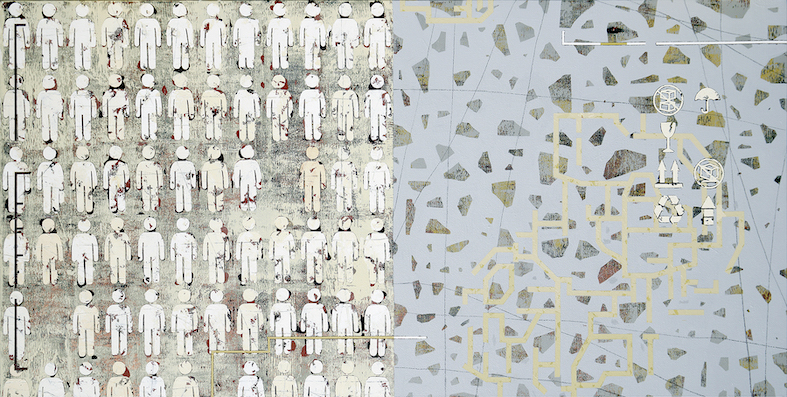
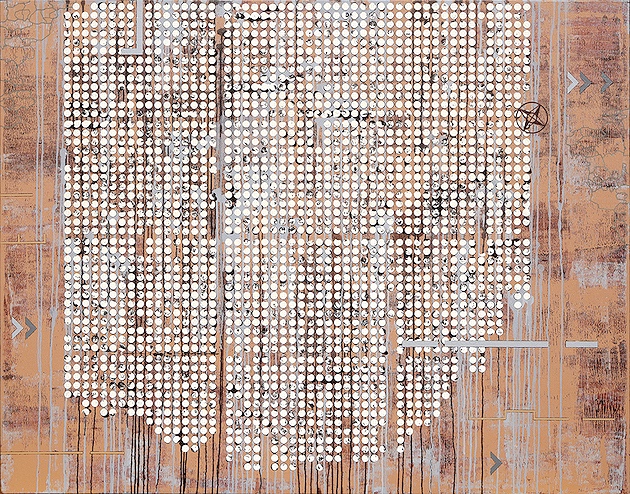
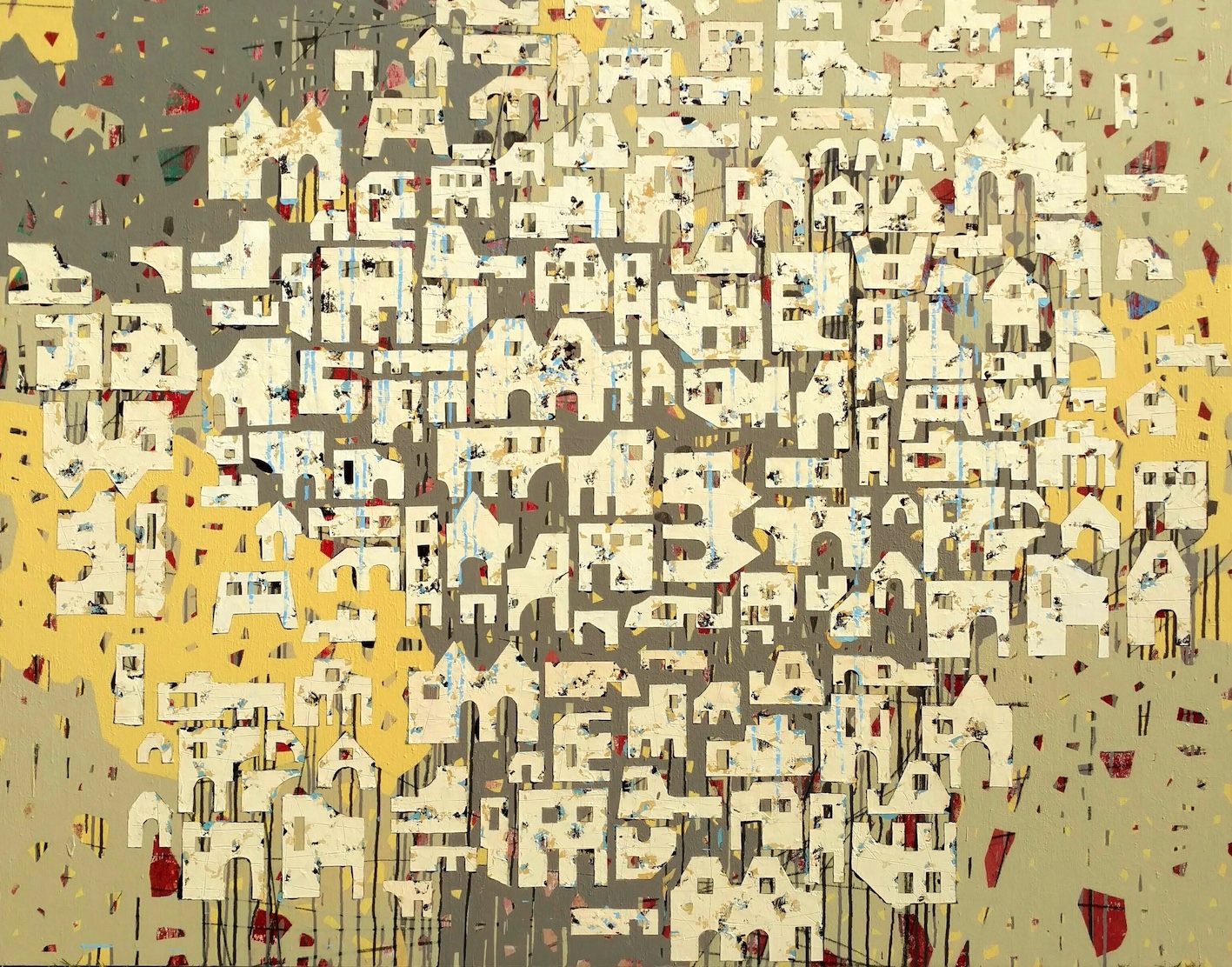
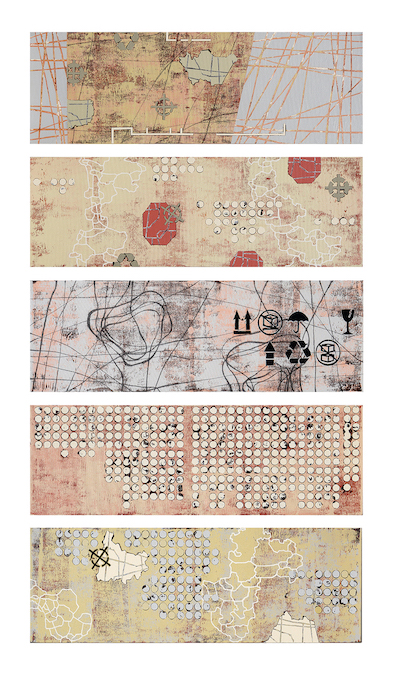
Peppered with archetypical outlines of people or dwellings, the artist proposes a template of an inhabited world, where man is stenciled into the landscape. The impressions of time are palpable in the treatment of the surface of the canvas, washed and dripping, the vestiges of an earlier layer peeping at us from under another. In Hamlet, as its title suggests, one sees a scattering of homes- or sections of homes, minus any distinguishing features. In Labyrinth, one is confronted with an equal division between the human multitude and a piece of land that is already marked with what appears to be the blueprint of a house on a mosaicked floor. Here Vichitra employs the standard pictorial symbols for ‘Handle with care’, ‘Fragile’, ‘Recycle’ to suggest a two-fold predicament- of responsible action when engaging with the environment, and of cultural preservation of the indigenous community. Most often used on packaging objects for consumption or travel, the symbols’ deliberate introduction reflects the artist’s emboldening intent to reference the objectification of land. With more distance from the surface, the silhouetted shapes of the human form are reduced to specs that together build and sustain a larger ecosystem. Unknown Origins harks to an unknown past owed to the rapid changes in the physiological makeup of land and our sense of place within it.
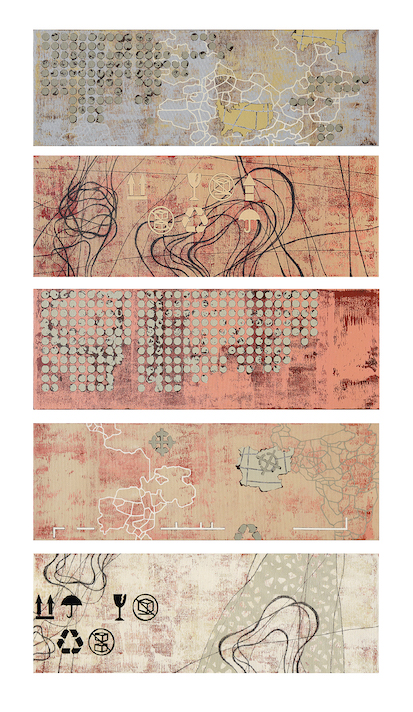
The anonymity and standardized language implicit in the stenciled forms function as place markers of non-representational topographies, so as to assume the work simply frames the surface of land- any piece of land where humans reside. In the twin series titled Endangered, 2018 comprising five panels each; Vichitra builds her composition vertically, like building blocks set one above another. The stacking is an interesting element in her practice, as also seen in the work- Witness, for it relates to modes of construction and development, and reflects a diversity of patterns in the overall fabric of land. The emotional appeal in the works is lucidly translated via their titles, emphasizing the fragility of not only a specific landscape, but also our own existence, for it is the surface of land to which we are bound.
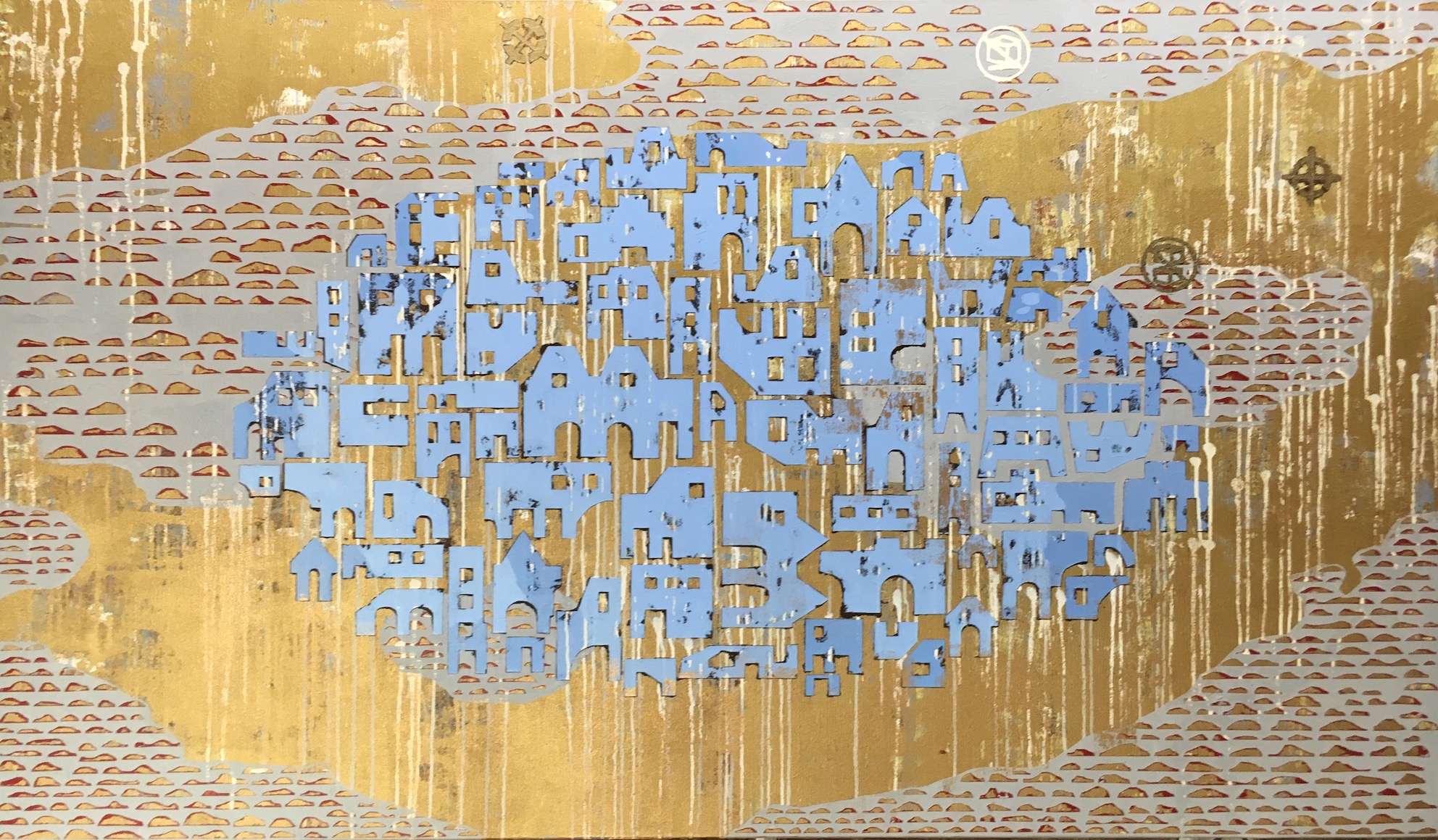
The nebulous nature of our world is more starkly conveyed in Revisited, 2018. A dense settlement, where the sense of communal bonding is easily imagined, floats against a cloud of gold. The superficiality of the surface heeds a darker reality- of prolific multiplication of dwellings, at odds with the sanctity of the surroundings, and the incongruity of the community wanting to preserve exactly what they are invariably destroying.
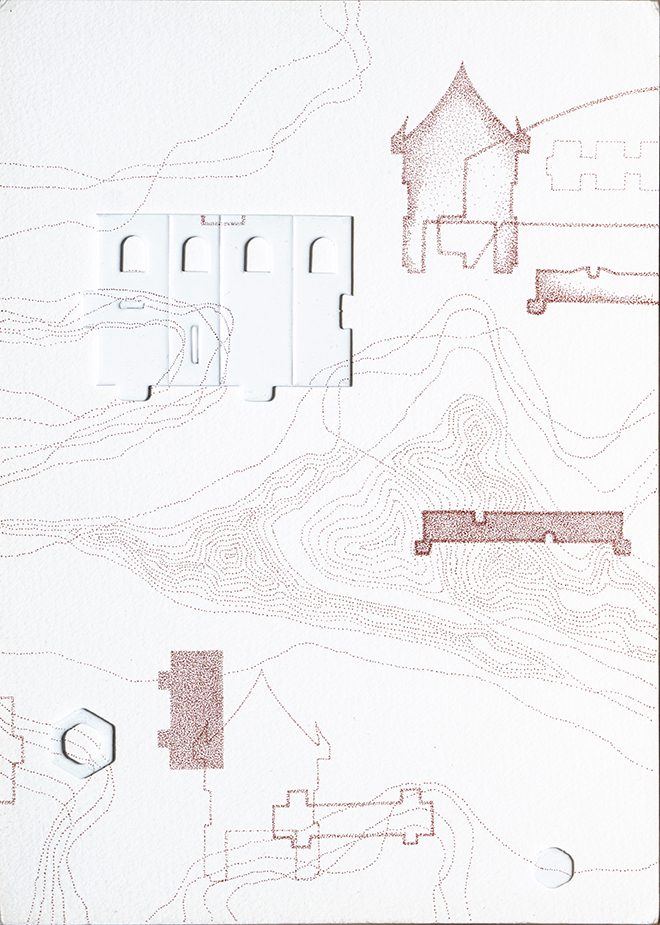
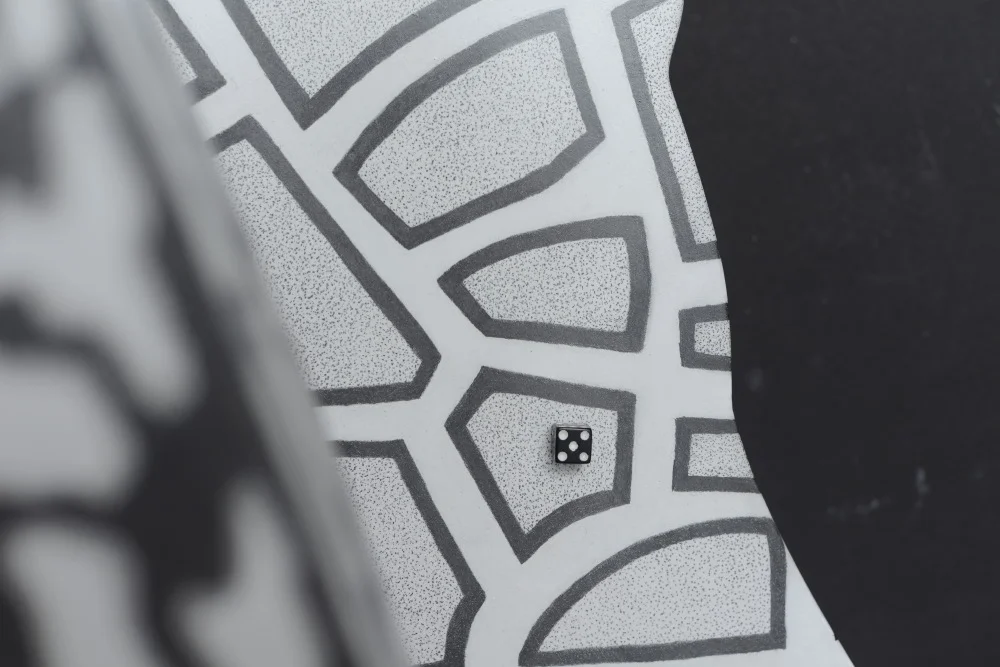
Drawing on Henry Lefebre’s Production of Space which views life in terms of a feedback loop between human activity and material surroundings, space is configured not as a container, but is continually ‘produced’ through activity. The cartographer’s tools of scales and symbols do at times, fall short of rendering the human aspect to places that cannot be verifiably surveyed or mapped. This inadequacy is cleverly resolved with the insertion of pieces of children’s puzzles into two suites of drawings that comment on popular and lost architectures respectively, that in turn attest to voids and structures being actively produced through human activity. The first suite titled Perfect-Imperfect draws on two cities that owe their fame and consequently large visitor numbers to the monuments that are located within their boundaries- the Taj Mahal in Agra, and the Leaning Tower of Pisa in Pisa. In the vein of loss and failure aligned with the intent behind their building, these two sites enjoy rather curious histories and have been at the center of many a controversy. The work is an ironic play on the geometric perfection of these monuments where generic architectural elements like arched gateways, domes, and columns are arranged to comment on the beauty of imperfection.
Destruction often preserves the memory of what is destroyed. Such is the case of the Medical College situated on top of the Chakpori hill that was destroyed during the Chinese invasion of Lhasa in 1959, only to be replaced by a TV tower. Connecting the sacred hill to the one on which sits Lhasa’s Potala Palace are now a string of prayer flags, a visual metaphor that bridges the distance between the lost and existing cultural sites. Deconstruction is a playful re-construction of the past and present, where fragments of these emblematic structures are gathered and presented in the second six-part suite of pen drawings. The workreflects the alternation between destruction and creation as an existential cycle that brings not only despair, but also reason for hope and strength.Both sets of drawings perform a mediating role—between epochs, traditions, and cultures, where the paradoxical qualities between violence and beauty co-exist on the same surface.




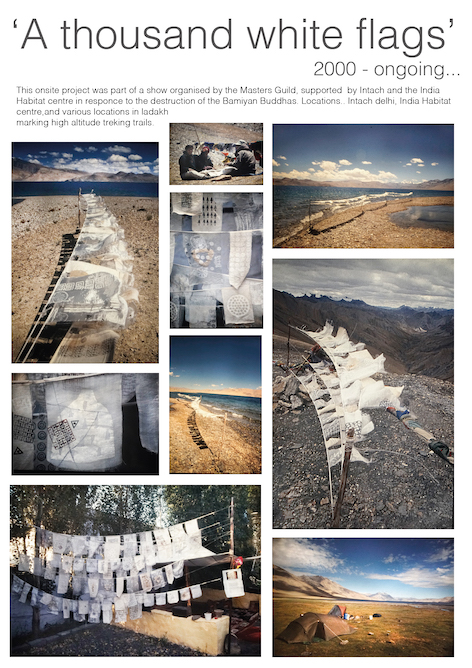
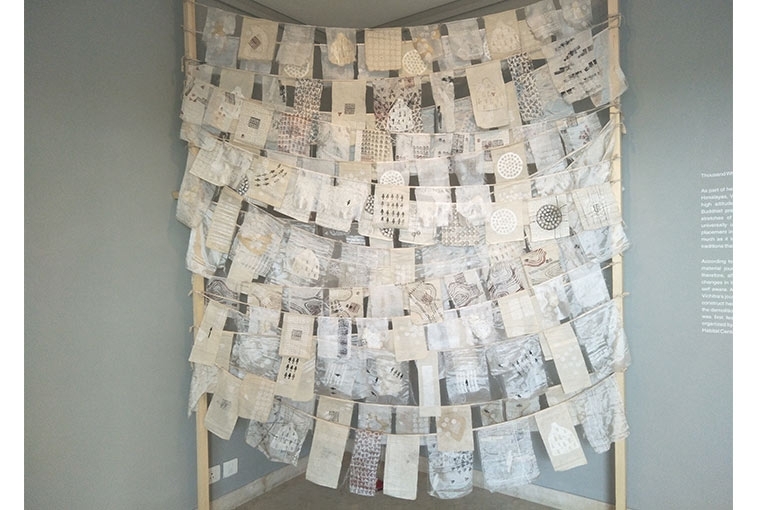
As part of her ongoing engagement with the mountain land of the Himalayas, Vichitra has since 2000, been placing white flags on high altitude sites and along trekking trails. Reminiscent of Buddhist prayer flags or cloth banners strung to bless the vast stretches of land beneath them, and of white flags that are universally understood as a symbol of peace, their consistent placement in the land is a symbolic gesture of peacekeeping as much as it is the planting of geographical footnotes embodying traditions that refuse to die. According to British archeologist Christopher Tilley, walking is a material journey where the physical body is immersed in and therefore, affected by the environment- say by time of day, by changes in the terrain etc. making the person walking extremely self aware. A Thousand White Flags, (2000 - present) represents Vichitra’s journey where spatial and temporal ‘presents’ coincide to construct her own process of archeology. Begun as a response to the demolition of the Bamiyan Buddhas in Afghanistan, the project was first featured at the exhibition And Buddha Smiles Again organized by the Masters Guild, supported by Intach and The India Habitat Centre, New Delhi in 2000.
As a final ode to her learning, or ‘an offering’ as Vichitra describes them are a row of nine prayer wheels, patterned in her visual language with an array of symbolic markings that speak of the land she has observed and the land left uncharted.
Kanika Anand,
March 2018
References:
- (ed.) Árnason Arnar, Nicolas Ellison, Jo Vergunst, Andrew Whitehouse.Landscapes Beyond Land: Routes, Aesthetics, Narratives, 2012
- Cruz-Pierre, Azucena & Landes, Donald A. Exploring the Work of Edward S. Casey: Giving Voice to Place, Memory, and Imagination, 2003
- Lefebre, Henri. The Production of Space, 1974
- Pellitero, Ana Moya. The phenomenological experience of the visual landscape. Research in Urbanism Series, [S.l.], v. 2, p. 57-71, Sep. 2011. ISSN 1879-8217.
- Tilley, Christopher. A Phenomenology of Landscape: Places, Paths and Monuments, 1997
- Tuan, Yi-Fu. Romantic Geography: In search of the sublime landscape, The University of Wisconsin Press, 2013
Mapping a World of Curiosities | Studio Art, New Delhi
Curiosity - A desire to know, an interest leading to inquiry, the quality of fastidiousness, a rare or strange object…
Four artists discover a world of their curiosities through the insertion or intervention of objects. By subverting the scale of everyday things, each artist attempts to explore a new curiosity- for Shivani Aggarwal, it’s possibly emotions derived from the mundane routine of a householder; for Priti Kahar, it is the looming fear that hinders social normalcy, for Parvathi Nayar it is discovering an alternate reality through an animated activation of her drawings and for Simrin Mehra Agarwal, it is the knotting of organic and mechanized engagements.

Curiosity - A desire to know, an interest leading to inquiry, the quality of fastidiousness, a rare or strange object…
Four artists discover a world of their curiosities through the insertion or intervention of objects. By subverting the scale of everyday things, each artist attempts to explore a new curiosity- for Shivani Aggarwal, it’s possibly emotions derived from the mundane routine of a householder; for Priti Kahar, it is the looming fear that hinders social normalcy, for Parvathi Nayar it is discovering an alternate reality through an animated activation of her drawings and for Simrin Mehra Agarwal, it is the knotting of organic and mechanized engagements.
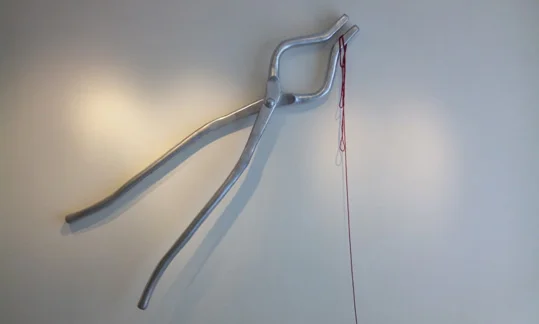
Pinned like a location on a map, against stratified lines, Priti Kahar’s ‘pins’ invert the idea of safety, and quite literally narrate the fear in need of being extinguished. The repetition in her imagery echoes an anger emerging from an inability to prove the futility of violence. A similar anxiety drives Shivani Aggarwal’s assemblages of red threads that represent her constant struggle to untangle the expectations and duties of a woman. Her incapacity to fulfill unending domestic roles compels a desire to challenge functions that are long outgrown, all too obvious in the ridiculously oversized kitchen tool titled I can’t hold anything anymore’.
Another set of dislocations marked in the photographed drawings of Parvathi Nayar exploits the element of chance in a contrived world that parallels the one we live in. Nayar cleverly places familiar objects like a chair, or cacti within her drawings, a voyeuristic peek into a surreal and rather enticing dimension, of a scale unknown. The fact that none of the photographs are photoshopped, makes for an even more perplexing outsider to insider view.
Similar shades of grey are addressed anew in Simrin Mehra Agarwal’s, Entangled, an exploration of the natural and man-made, and a questioning of the symbiotic or parasitic confrontations therein. The existential and the temporal are recitations that consume a hybrid form, detailed in each etch of the tree’s bark that stands in combat with the mechanized workings of human innovations.
Mapping a world of curiosities addresses the dichotomy of society and nature, of subject and object. Each work is a mapping of hungered, thwarted and teased objects - a means of indulging our desires and repeating unappeased thoughts. The show is a theatre of abstractions, where each object performs a role on a stage of the artist’s own making and in doing so, reveals the fragility of all worldly relations- of power, gender, animate and inanimate matter.


Unseen Passages at Gallery Art & Aesthetics, New Delhi
Pallavi Singh’s series Desire to be Desired explores her observations of male vanity and the conditions that feed it. Soghra Khurasani’s work on the other hand, is about freedom of thought and draws from a deep angst against unjust social and religious prescriptions.
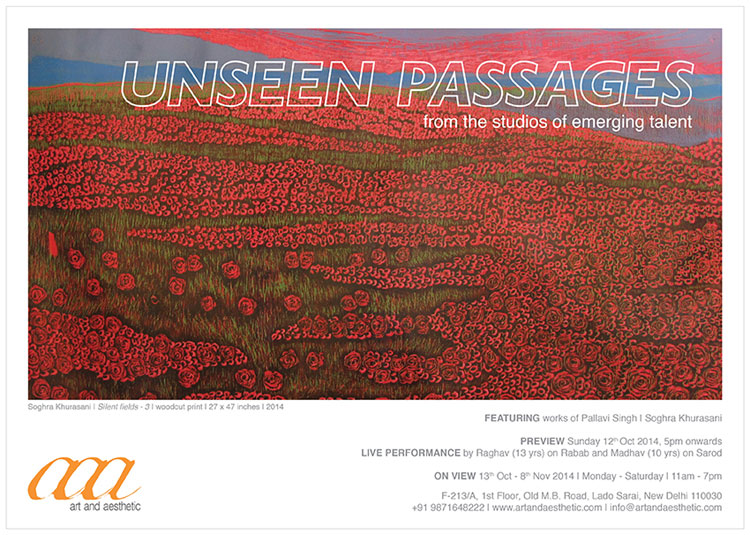
This season, Gallery Art & Aesthetic presents work from the studios of two young and observant women artists.
Pallavi Singh’s series Desire to be Desired explores her observations of male vanity and the conditions that feed it. Punctuating the generation of the millennials is easier and faster access to information resulting in renewed socialization and an increased interest in one’s self-image. Singh breaks away from the stereotype by focusing on the urban male to whom fashion and grooming are an important norm. A middle–aged potbellied bald man is her choice of protagonist, comically represented fussing over his physical appearance. The comment is intended to be both realistic and ironic, with Singh ensuring that the viewer steps aside from the work wearing a smile.


Pallavi Singh (b. 1988) graduated with a Masters in Fine Art from the Delhi College of Art in 2011. She has been greatly influenced by English journalist and writer Mark Simpson’s writings on metrosexuality and her correspondence with him has helped develop her sensibilities in art. Her continuing research explores the specified rules of appearance and costume amongst men in Indian mythology and fables. The artist lives and works in Delhi.
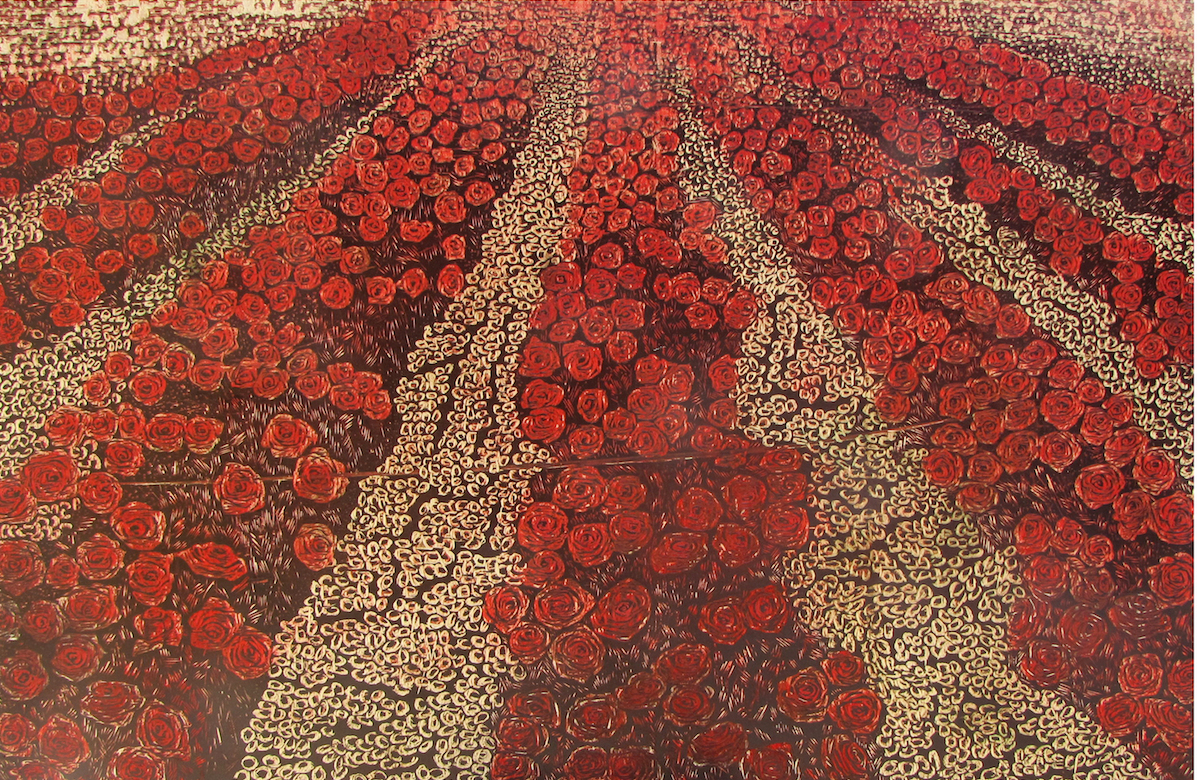
Soghra Khurasani’s work on the other hand, is about freedom of thought and draws from a deep angst against unjust social and religious prescriptions. Her large-scale prints are compositions dominated by red: a colour that she feels expresses her rage and despair at the redundant injunctions imposed on common people. By morphing cells of blood into roses through valleys and volcanoes, her art posits the bittersweet moments of free will that survive the hypocrisy and politics of institutions governing our lives. Khurasani’s current series Silent Landscapes reveals a resistance to violence and the telling impact of its trauma in rows, swirls and circles that inform the viewer of a never-ending cycle of repression and defiance.


Soghra Khurasani (b. 1983) graduated with a Masters in Printmaking from MSU, Baroda in 2010. Sensitive to the effects of power play and mass control, she observes and gives voice to minority groups who are constantly shuffled as per the changes in dominant ideology. The etching and stamping of the printmaking process resonates her wish to push aside social stigma and stereotypes, making way for independent and fresh thinking.The artist lives and works in Baroda.