Your Custom Text Here
Curator's Pick, The Pool | Where's Art
Curator's Pick for 'The Pool' of Where's Art
Artist from India: Astha Butail
Kanika Anand presents Astha Butail
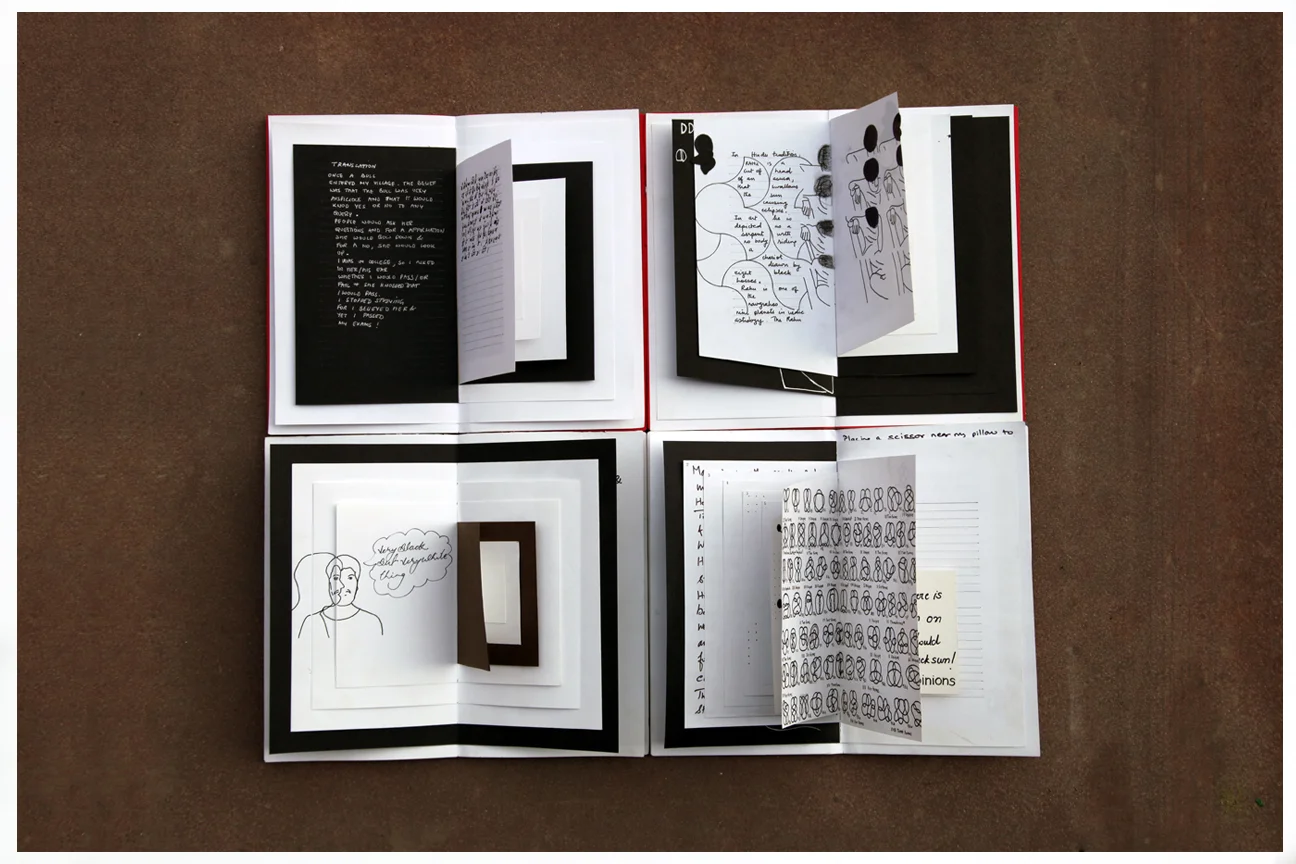
Astha Butail (b. 1977, India) is an emerging artist whose practice is inspired in part by her work as a fashion designer and in part by her deep study of Indian mythology and ancient scriptures. Her artistic direction and sensibilities are well defined in the poignant open book project she conceived in 2012 titled A story within a story (ongoing). Here, Butail draws from the manner in which oral traditions are passed on through generations and handcrafts an archive of a hundred catalogued books based on the Black Sun (2012). Each is filled by collective contributions wherein the audience is invited to write, draw, engage, react to a note on a prompt card that becomes the title of the book marked systematically as 1/100, 2/100 and the like. The outcome is a beautiful collection of people’s experiences, stories, poems, sketches and drools that interact with or overlap each other. She deftly controls the overall aesthetic of the books, each encased in a sleek retro-looking wooden cover, with leaves of paper choicely selected in white, black, red or grey, bound by thread and mountable at random on the wall as an installation.


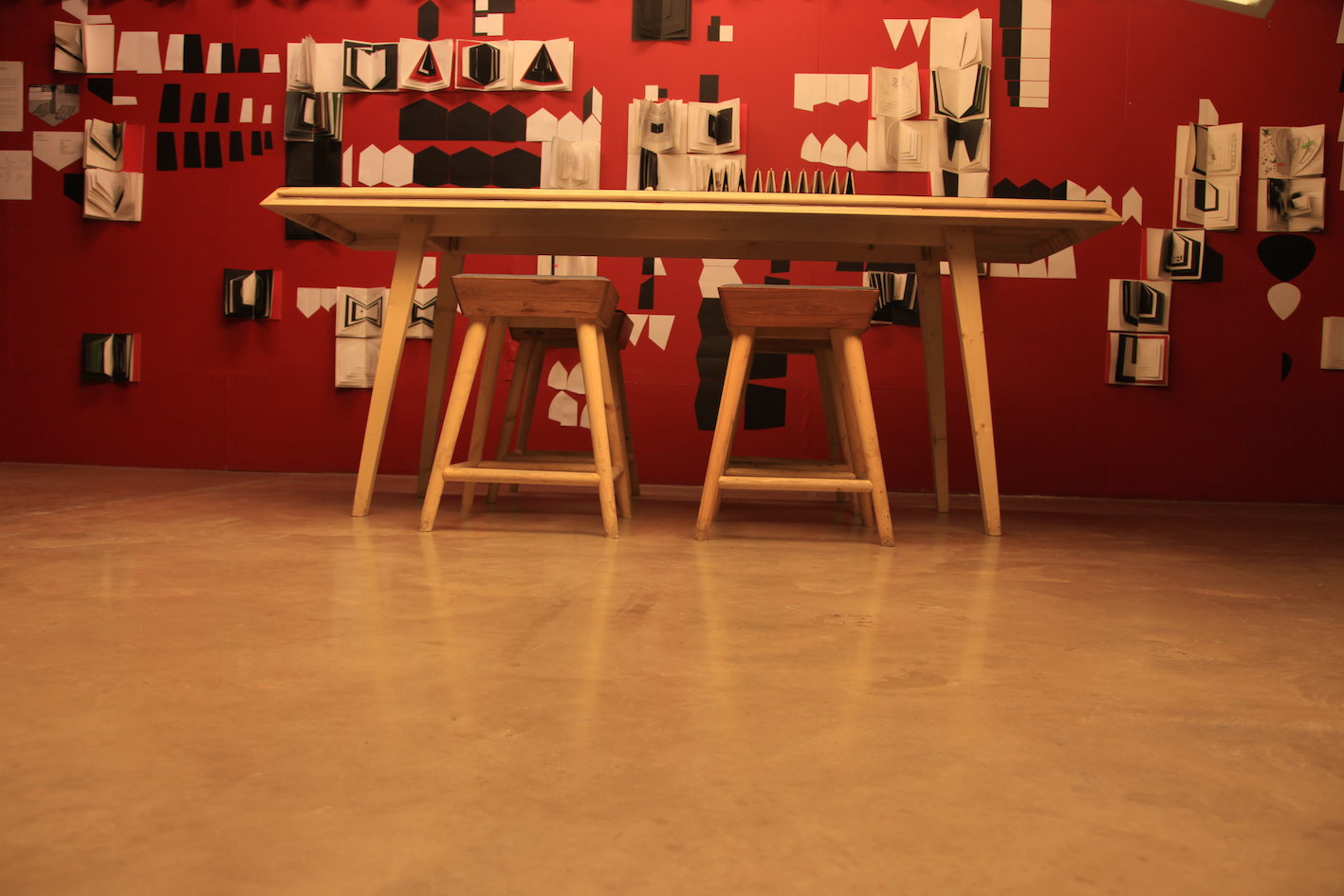
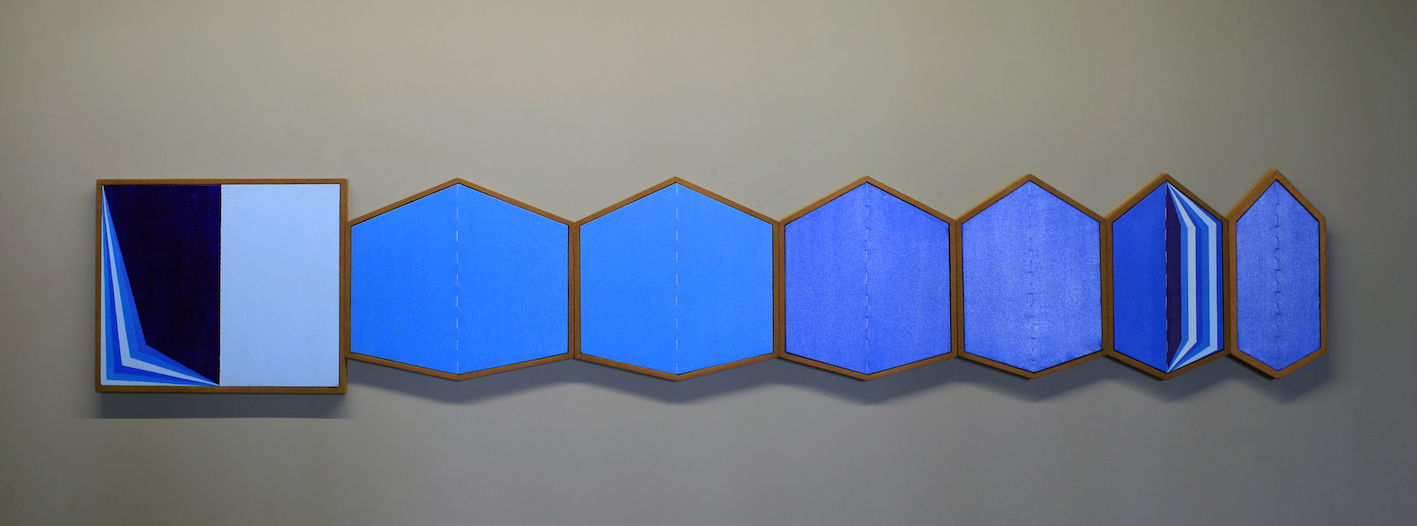
Butail’s fascination with memory and the varied libraries of its keeping is complimented by her eye for symmetry that guide the construction of her works. No two books are made the same, the pages cut as eyelets, squares and other geometric shapes, with a black page peeping from under the white that is overlaid. From the concluding work in blue began another series of ten books titled Stretch out in the light (2013) that recently showed at Masquelibros, Artist Book Fair, Espaciovalverde, Madrid. She intends for these and the others that follow to grow with more contributions and be archived for the future as repository and relic of our current times and its thoughts. The artist lives and works in Gurgaon, India.

Reviewing South Asian Art at FIAC, Paris | SaffronArt Blog
As guest blogger, I write about my impressions of FIAC, Paris (2012) and the representation of Indian artists at the fair.
Paris: Foire Internationale d’Art Contemporain, popularly know by the acronym FIAC, is France’s primary fair of contemporary art, hosted at the Grand Palais in Paris in October every year.
Enthused by my first visit to the fair and the general buzz of art events around it in Paris, I made my way one rainy evening to discover for myself the depth of the hullabaloo. The fair offered the usual suspects of the contemporary art world, both in terms of galleries as well as artists, such as White Cube, David Zwirner, Lisson, Victoria Miro, Galerie Perrotin along with their blue chip artists Damien Hirst, Tracey Emin, Cindy Sherman, Anish Kapoor & Yayoi Kusama. Takashi Murakami bedazzled and Paul McCarthy mocked… and shocked! Incidentally, this edition of FIAC marked Gagosian Gallery’s debut at the fair. These art market biggies dominated, if not wholly comprised the selection at FIAC.
Indian representation was limited to artists who already have a market in Paris and could be better defined as international artists of Indian origin. Widely exhibited in Europe, Mithu Sen’s solo show ‘Devoid’ opens today at Galerie Nathalie Obadia in Paris. This will be the artist’s first solo in France, although her work has been exhibited at FIAC before. Hanging in the gallery’s booth at FIAC was Mithu’s You taste like Pao Bhaji alongside a sculptural work by the gallery’s long time represented artist, Rina Banerjee. Banerjee already has a marked presence in Paris; noteworthy of mention was her solo exhibition, Chimeras of India and the West at the prestigious Guimet Musee in 2011.
A series of 10 ‘Untitled’ drawings by N.S.Harsha hung on the outside wall of Greene Naftali Gallery (New York). Zarina Hashmi’s beautiful gold flaked ‘Tasbih’ hung in the corner of Jeanne-Bucher/Jaeger Bucher’s (Paris) booth, in the deserving company of Joan Miro and Susumu Shingu. Tasbih is from Zarina’s most recent body of work shown at the gallery in a solo exhibition titled Noor last year.
A painted store shutter titled Mumtaz by Atul Dodiya and a painting by Jitish Kallat adorned two main walls of the large booth of Galerie Daniel Templon (Paris). The last day of FIAC coincided with the conclusion of Atul Dodiya’s first solo exhibition in Paris – Scribes from Timbuktu at their gallery space. The gallery has in the past supported Indian and other Asian artists, showcasing works by Sudarshan Shetty, Anju Dodiya, Hiroshi Sugimoto & Yue Minjun.
Two round shiny Anish Kapoor steel works in gold and purple, one each at the booths of Lisson (London/ Milan/ New York) and Gladstone Gallery (New York/ Brussels) shimmered akin to the gloss of the fair itself. But for me, the fair lacked spunk – no experimental works, no new names, no interesting project booths and notably no Indian galleries! It was all that I ‘expected’, but then again I’m no collector.
FIAC, Paris runs several parallel events and programs around the fair. More information is available at http://www.fiac.com/.
A Play of Shadows and Reflections that Impresses on the Visual Imagery of Ranbir Kaleka | SaffronArt Blog
New Delhi: Ranbir Kaleka’s paintings, digital prints, video projections and media works have always fascinated me. They are not only imaginative, but are indeed, a gripping way of telling a story.
Ranbir opened the evening with a slide of his ancestral haveli in Patiala, where he grew up. The image was but a collage of photographs holding the structure up and containing its memories forever. Although not nostalgic of the physicality of his home, Ranbir vividly explained that his sheltered upbringing and childhood interactions, almost exclusively with family members, led him to observe things and experiences more intently. Ranbir’s play was built on tales, mirrors and their reflections, shadows and their movements. He drew comfort in their complexities, a trait that reflects in his work to date.
Ranbir spoke of his family as story-tellers, either inventing or relating stories true to their character and personal fantasies. His imagery does not appear to acknowledge linear order or chronology; events overlap and beings are dense and contorted.
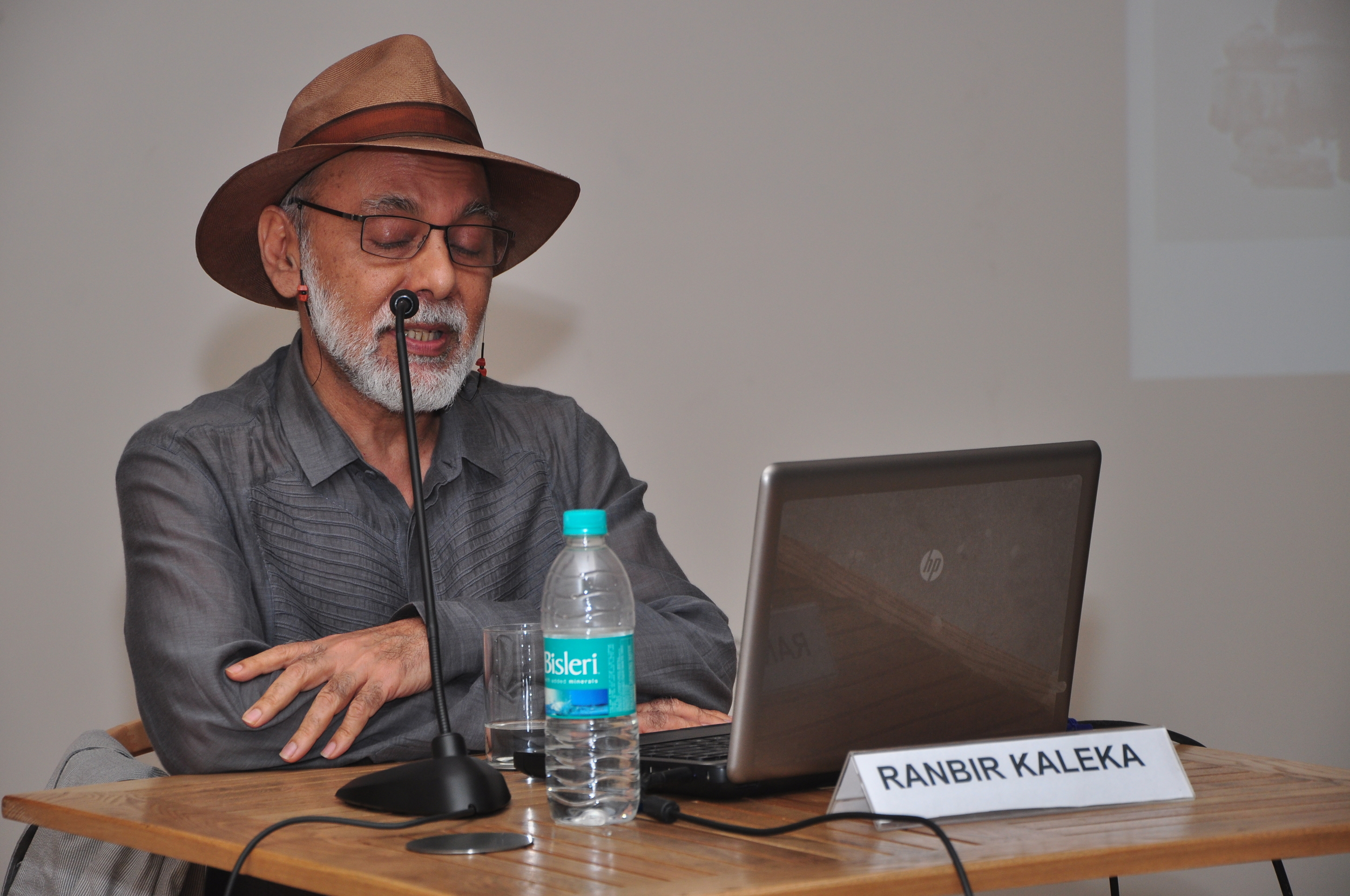
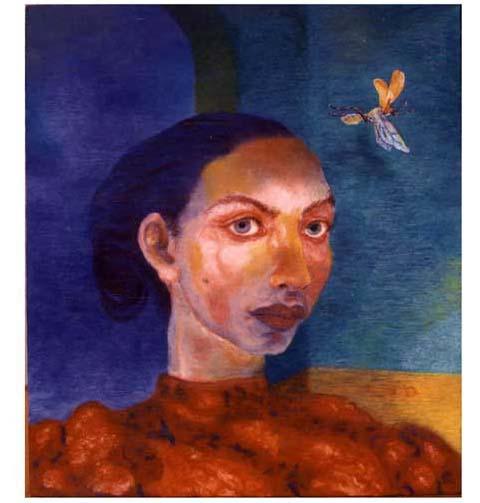

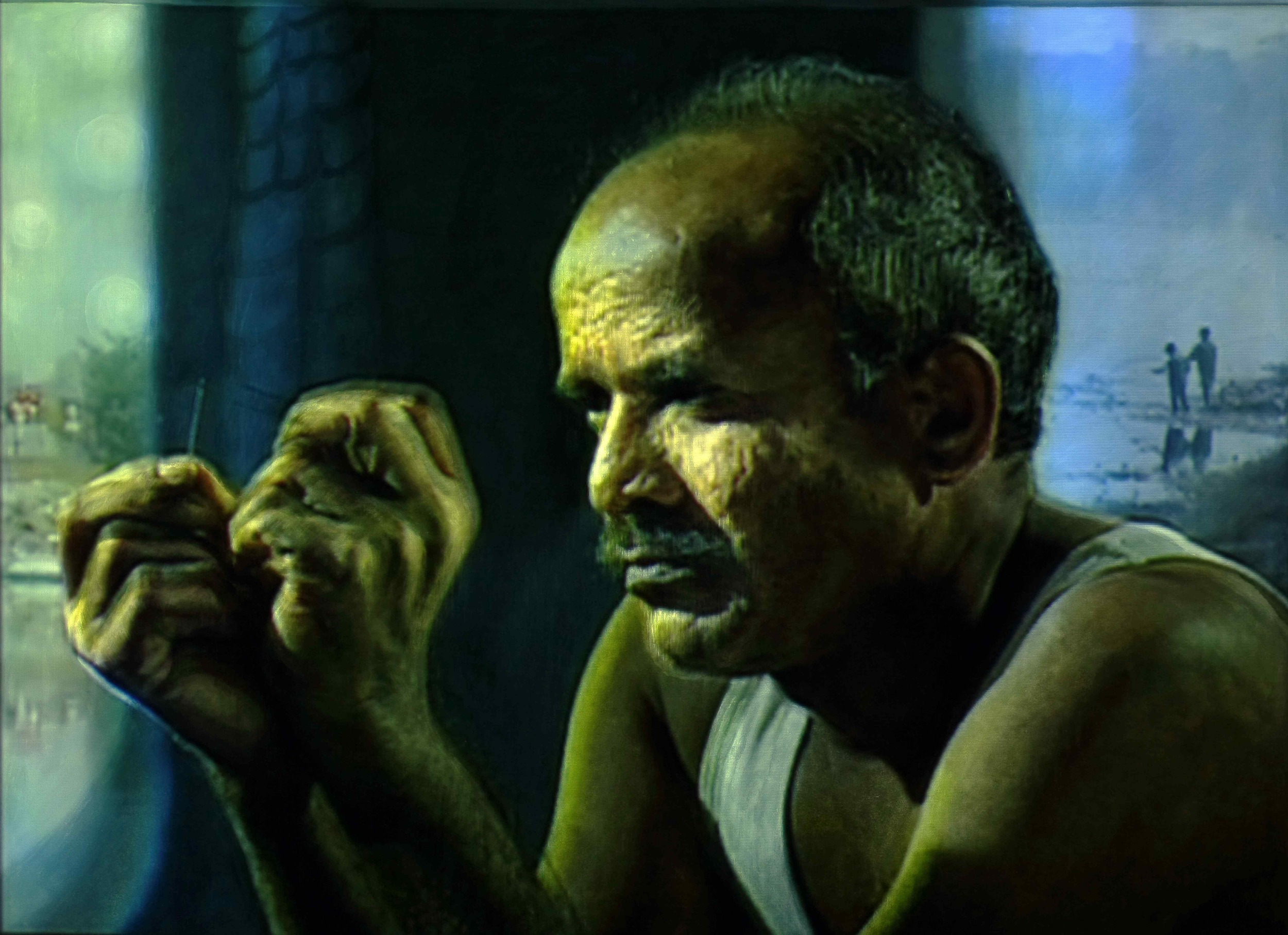
The artist took us through his early paintings, done as an art student, first at Punjab University, Chandigarh, and then at the Royal College of Art, London. Here we see the initial but lasting influences of calendar art, a somewhat sophisticated kitsch, and most significantly the impact of cinema in each painted tableau. The latter became a tangible part of his work in 1999 in ‘Man Threading the Needle’, Ranbir’s first video projection on canvas. The merging of two mediums allowed the viewer to enter a deeper space of experience, yet their incongruity meant the experience was also elusive. Through a series of such works in the 2000s including ‘Man with Cockerel’ (2004), ‘Fables from the House of Iban’ (2007), ‘He was a Good Man’ (2008), ‘Sweet Unease’ (2010) and the like, Ranbir engages us in poignant moments where protagonist identities remain wanting and/or becoming. This is also true of his digital prints, paintings on canvas and series of staged photographs.

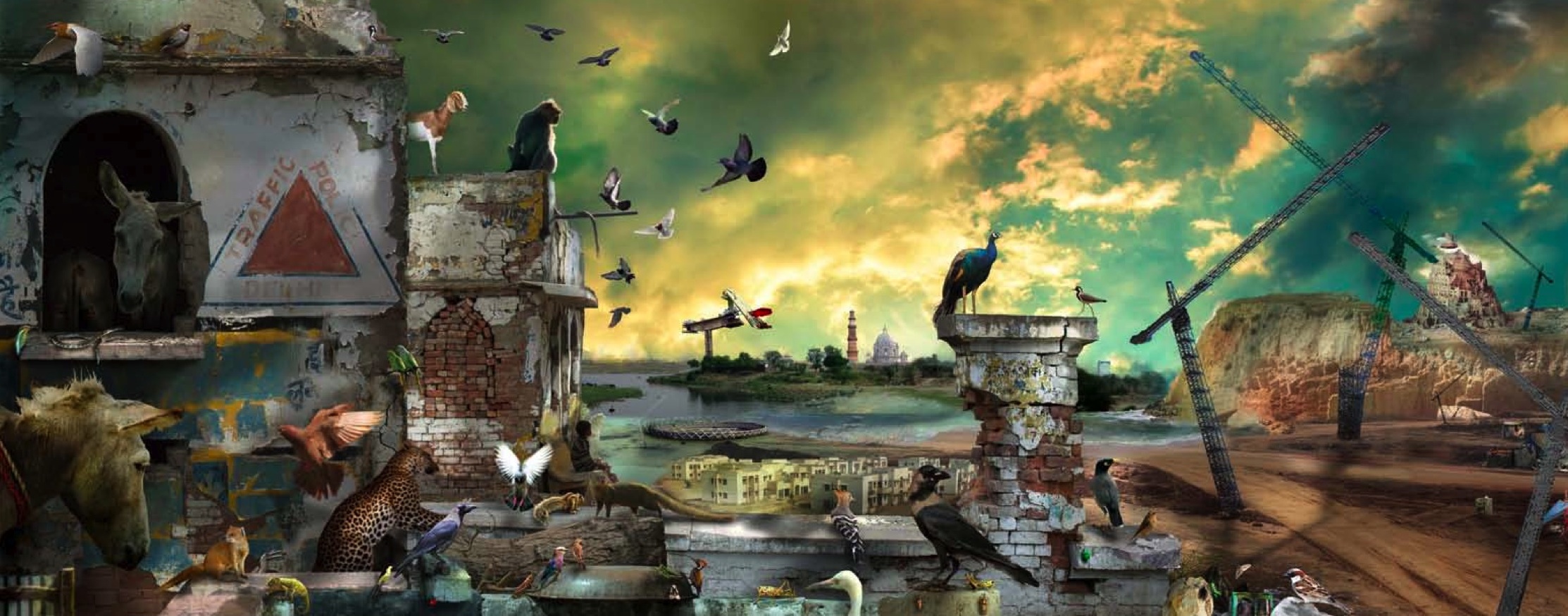
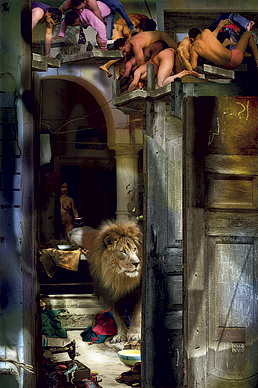
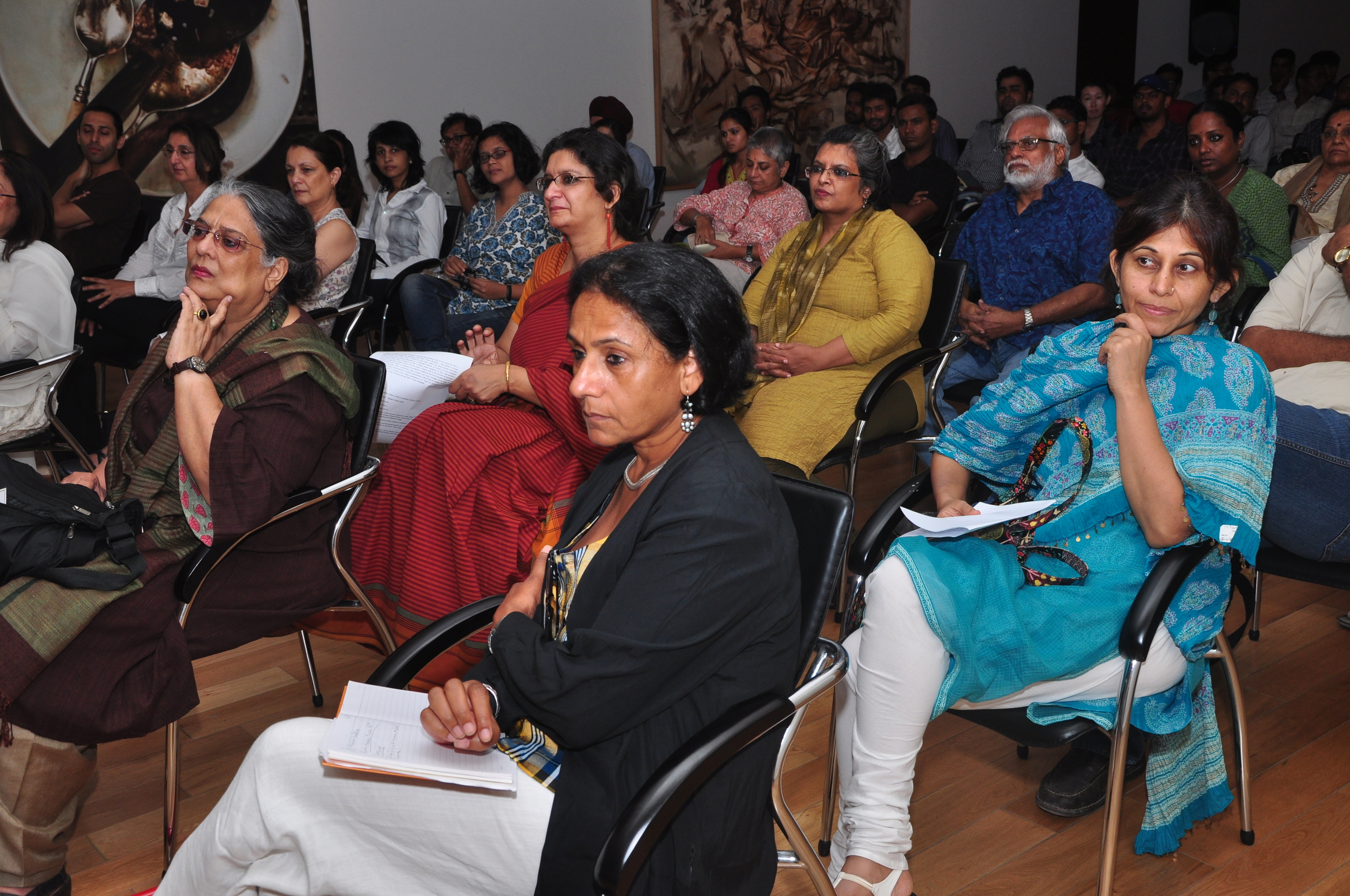
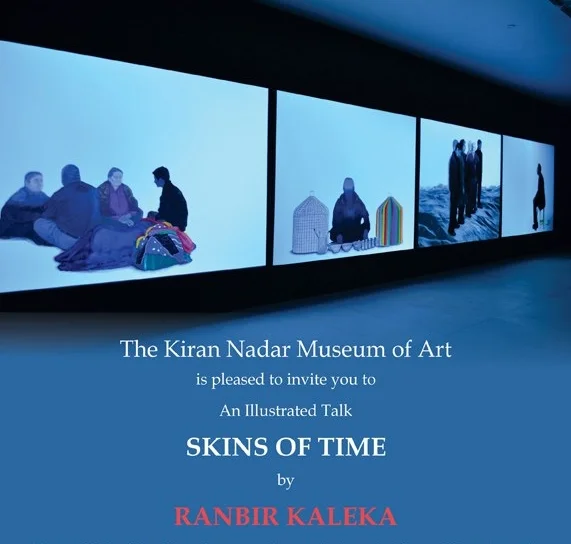
It was a delight to hear the usually bashful artist speak of his work. And personally, it was incredibly gratifying to see his early works and note the strains of memory and conditioning in his imagery. The talk, initiated by KNMA, New Delhi, was a corollary event to their current exhibition Crossings: Time Unfolded II, of which Ranbir Kaleka’s 2010 four-channel video projection also titled Crossings is on display.
Ranbir Kaleka’s first major exhibition in New Delhi since 1995 was held at Saffronart in December 2011-January 2012. For more on the show, click here.